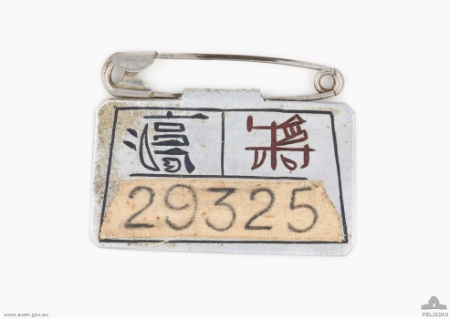
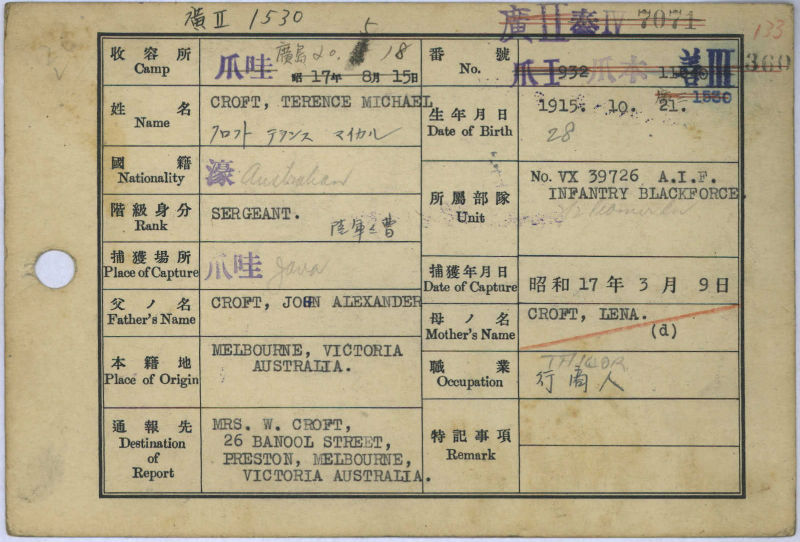
Typical Japanese record of prisoner of war (see below photo for back of record). This one is for 31081 (VX39726) Sergeant Terence Michael Croft. id no. NAOA_VX39726-D1
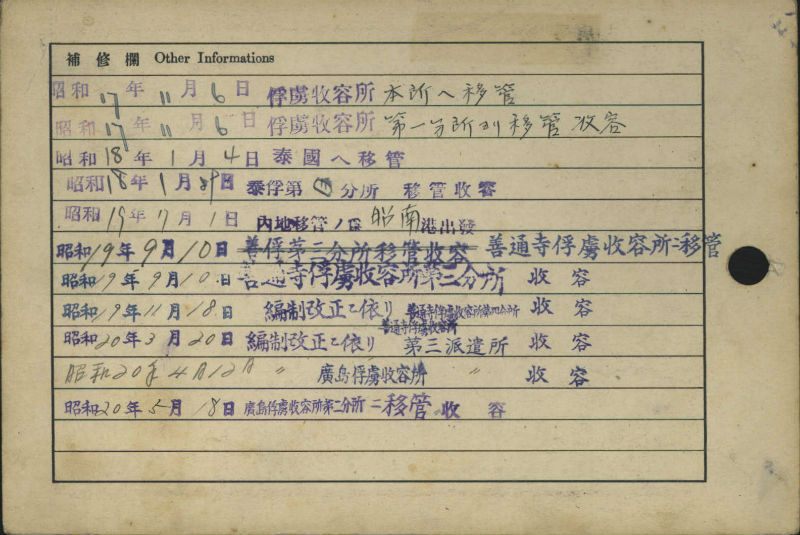
Typical Japanese record of prisoner of war (see above photo for front of record). This one is for 31081 (VX39726) Sergeant Terence Michael Croft. id no. NAOA_VX39726-D2
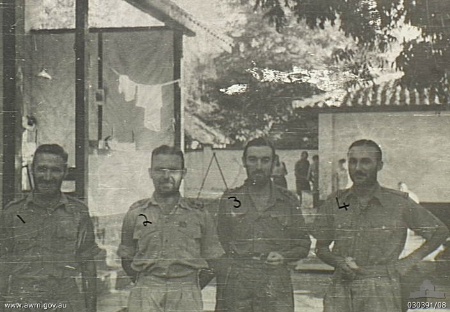
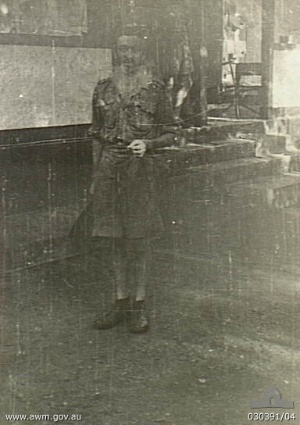
Informal portrait of Captain (Capt) Stewart John Handasyde, 2/2nd Australian Pioneer Battalion, in the Officers' Compound, Bicycle Camp. Capt Handasyde had just been returned to the camp from the hands of the Kenpeitai (Japanese Military Police) who had tortured him for 40 days in an endeavour to obtain from him matters of military importance to the Japanese. One of their methods of torture was to place pieces of bamboo between his fingers, drawing them backwards and forwards until the flesh burned to the bone. Despite such brutal treatment the Japanese were not successful in gaining any information. AWM id no. 030391/04
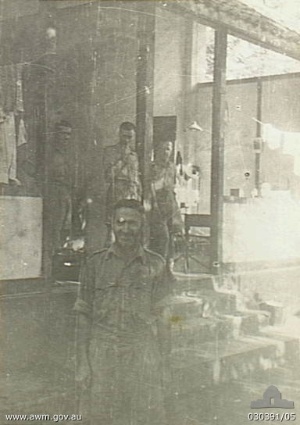
Informal portrait of Lieutenant Colonel (Lt Col) J M Williams, Commanding Officer, 2/2nd Australian Pioneer Battalion, in the Officers' Compound, Bicycle Camp. Lt Col Williams had just been returned to the camp after having been subjected to torture for 30 days by the Kenpeitai (Japanese Military Police) in an attempt to obtain from him matters of military importance. Persistent refusal to capitulate to the Japanese inquisitors was met by such treatment as poisoned food which brought on excessive vomiting and filling the stomach with water and being jumped on. On one occasion he was taken out before a firing squad. He was humiliated by being imprisoned with native prisoners and allowed only an occasional wash, but was not permitted to shave. AWM id no. 030391/05
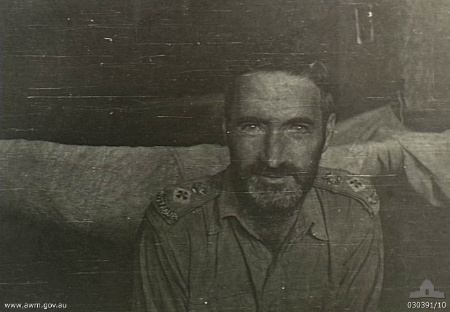
Informal portrait of Lieutenant Colonel J M Williams, Commanding Officer, 2/2nd Australian Pioneer Battalion,in the Officers' Compound at the Bicycle Camp after his release from the Kenpeitai (Japanese Military Police). He is shown with the beard which grew while in captivity as a result of not being permitted to shave. AWM id no. 030391/10
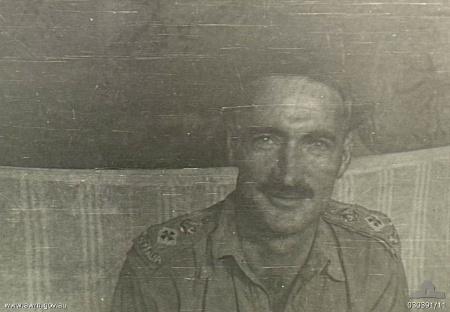
Informal portrait of Lieutenant Colonel J M Williams, Commanding Officer, 2/2nd Australian Pioneer Battalion, in the Officers' Compound at the Bicycle Camp. Colonel Williams has removed the beard which grew while he was in the hands of the Kenpeitai (Japanese Military Police). He was tortured for 30 days and was humiliatiated by not being allowed to shave and only occasionally allowed to wash. AWM id no. 030391/11
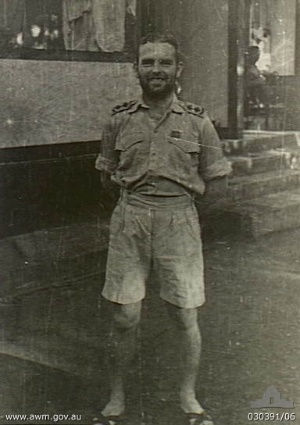
Informal portrait of Lieutenant (Lt) Mullens, 2/2nd Australian Pioneer Battalion, in the Officers' Compound, Bicycle Camp. Lt Mullens has just returned to the camp after being subjected to torture for nine days by the Kenpeitai (Japanese Military Police) in an unsuccessful attempt to obtain military information. AWM id no. 030391/06
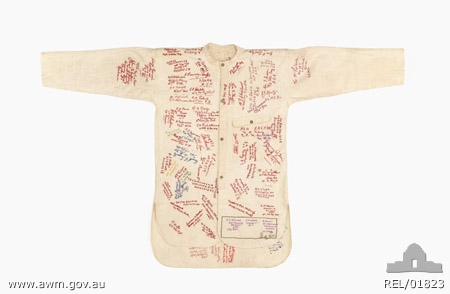
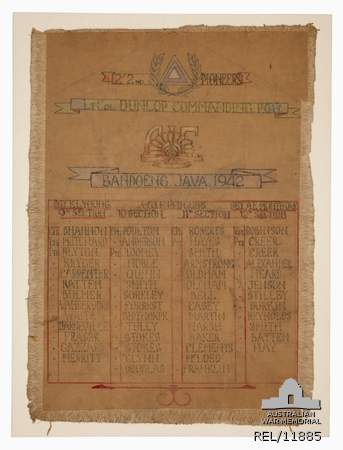
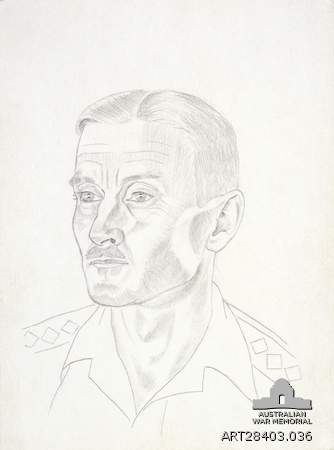
Burma Railway. 1943-1945. Portrait of VX15670 Captain Stewart John Handasyde, 2/2 Pioneer Battalion, 2 AIF, of 267 Church Street. The artist, Jim Collins, was a member of A Force, one of the work parties forced to construct the Burma-Thailand Railway. By the beginning of 1943 many prisoners had died and it was clear to their senior officer, Brigadier Arthur Varley, that the number of deaths would only increase. Collins was instructed by Varley to draw "portraits of fellow POWs, some of whom would not survive the war." The drawings - almost 100 of them - were done in secret using rudimentary materials provided by Varley. It was intended that the collection be kept together as a reminder of the men who had died and the suffering endured by the survivors. The artist wrote: 'The big majority of the subjects were AIF personnel; the balance being of other Allied POWs in the same area'. AWM id no. ART28403.036
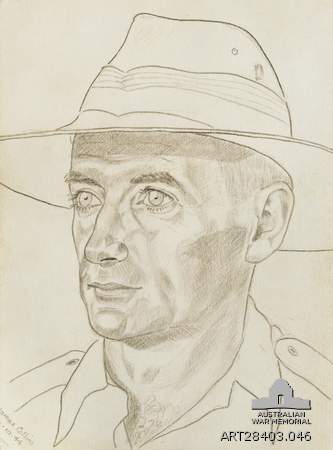
Burma Railway. 1944. Portrait of Lieutenant Colonel John Williams, Commanding 2/2 Pioneer Battalion. The artist, Jim Collins, was a member of A Force, one of the work parties forced to construct the Burma-Thailand Railway. By the beginning of 1943 many prisoners had died and it was clear to their senior officer, Brigadier Arthur Varley, that the number of deaths would only increase. Collins was instructed by Varley to draw "portraits of fellow POWs, some of whom would not survive the war." The drawings - almost 100 of them - were done in secret using rudimentary materials provided by Varley. It was intended that the collection be kept together as a reminder of the men who had died and the suffering endured by the survivors. The artist wrote: 'The big majority of the subjects were AIF personnel; the balance being of other Allied POWs in the same area'. AWM id no. ART28403.046